
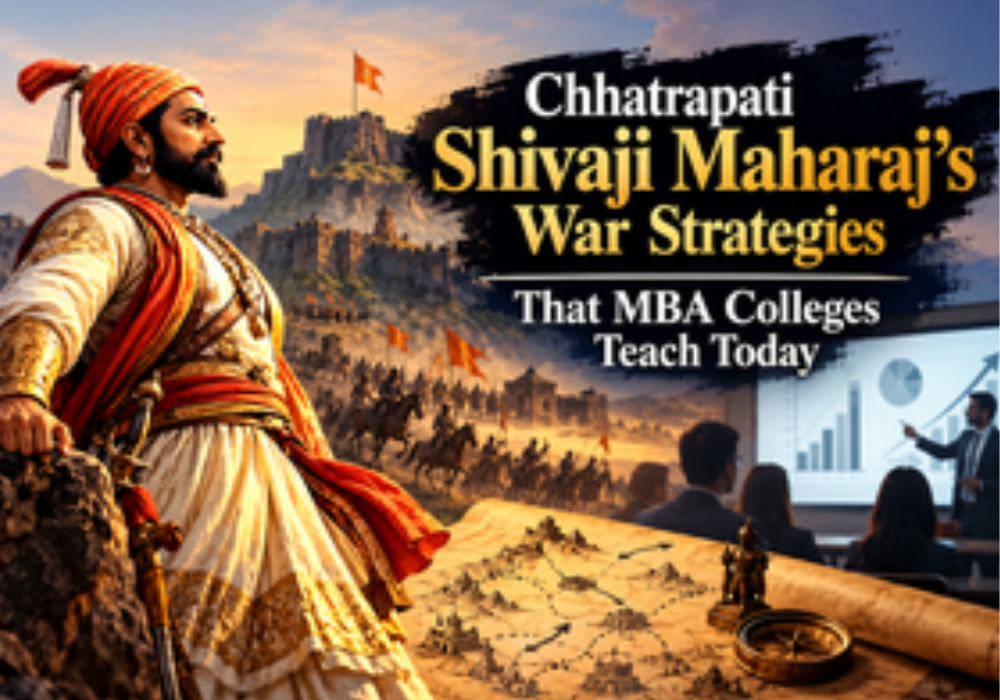
Many management trainers and professors cite the examples of Shivaji's leadership, policies and crisis management.
Guerrilla warfare, spy networks, fort management and impeccable planning: Shivaji's qualities are as useful in today's strategic management.
Introduction
In today's competitive world, every business has to face competitors. Small startups have to survive in front of large companies with big capital, big teams and big brands. The answer to this can be found in Chhatrapati Shivaji Maharaj's way of working. Many management trainers and professors cite the examples of Shivaji's leadership, policies and crisis management. Let's look at the main lessons here.
1. Guerrilla warfare (Ganimi Kava): Maximum results with minimum resources
With a small army against powerful enemies, Shivaji attacked suddenly and swiftly. This was the basis of the guerrilla tactic. He used hills, passes and forests wisely.
Today's lesson: A small company doesn't need to compete head-on with a big company. By choosing a specific segment (niche market), it can create dominance there. This is called "Disruptive Strategy" today.
2. The spy network: Information is power
Thanks to the intelligence department under Bahirji Naik, Maharaj got accurate information about enemy movements, treasury, the condition of forts and plans. Thorough preparation lay behind successful campaigns.
Today's lesson: Market Research, Competitor Analysis and Data-driven Decision Making matter. A decision taken without proper information is like shooting an arrow in the dark.
3. Fort management: Precise planning of resources
Shivaji conquered, built and repaired many forts. Every fort was staffed with people of different castes and communities, officers were made to supervise each other, and arrangements for grain, ammunition and water were made in advance.
Today's lesson: Supply Chain Management, Risk Distribution and Checks and Balances. Not giving all the power to one person is the basis of good governance.
4. The navy: Vision for the future
Recognizing that whoever controls the sea protects the kingdom, trade and coast, Shivaji built his own navy and constructed sea forts like Sindhudurg.
Today's lesson: Future-ready Thinking. Investing by anticipating changes in technology and the market in advance.
5. The Afzal Khan episode: Preparation after recognizing the danger
At the meeting with Afzal Khan near Pratapgad in 1659, Maharaj had made full preparations, considering every possibility. The meeting place, army positions, weapons and men were all decided in advance.
Today's lesson: Risk Management and Contingency Planning. A leader with a "Plan B" ready succeeds in a crisis.
6. Escape from Agra: Calm mind even in a crisis
In 1666, Maharaj escaped cleverly from Aurangzeb's captivity. For this, he took time, made a plan and used trusted people.
Today's lesson: Crisis Management. When failure or crisis comes, find solutions with restraint instead of panicking.
7. Ashtapradhan Mandal: Decentralized administration
For governance, eight major departments, such as the Peshwa, Amatya, Sachiv and Senapati, were created, and each one's responsibility was clearly defined.
Today's lesson: Delegation of Authority and Organizational Structure. When the right person is given the right responsibility, the organization grows.
8. Care for soldiers: The human face of leadership
Do not trouble farmers, respect women, don't damage crops, give soldiers timely salaries: Maharaj enforced such discipline strictly.
Today's lesson: Employee Welfare and Ethical Leadership. People give their lives for a leader who takes care of his people.
What should students learn?
Shivaji's principle Modern management concept
Ganimi Kava Niche Strategy / Disruption
Bahirji Naik's spies Market Intelligence
Fort management Supply Chain / Risk Control
Navy Long-term Vision
Ashtapradhan Mandal Delegation / Org Structure
Escape from Agra Crisis Management
Conclusion
Shivaji Maharaj was not just a warrior, but an excellent administrator, far-sighted leader and organizer. His decisions were based on study, planning and public welfare. Whether you are a student, an entrepreneur or a working professional, you can apply these principles to face any challenge.
"Dream big with few resources, plan flawlessly and take people along."
Comments (0)
No comments yet.