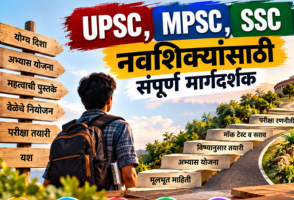
With the right direction, even an ordinary student can succeed. First, let's understand the three exams.
Here is simple information about the structure, syllabus, stages of preparation and the right books for the UPSC, MPSC and SSC exams.
Introduction
Lakhs of students in Maharashtra start preparing for competitive exams every year, dreaming of government service. But many get stuck midway due to lack of information, mistakes in guidance and poor planning. With the right direction, even an ordinary student can succeed. First, let's understand the three exams.
1. Introduction to the three exams
Exam body Main posts
UPSC (Civil Services), Union Public Service Commission IAS, IPS, IFS and other central services
MPSC (Rajyaseva), Maharashtra Public Service Commission Deputy Collector, DySP, Tahsildar, Group Development Officer
SSC (CGL, CHSL, MTS), Staff Selection Commission Posts in central government offices, income tax, customs, clerical posts
Note: A large part of the UPSC and MPSC syllabi is the same, so preparing for both together is possible.
2. Eligibility (general information)
Educational qualification: A degree in any stream is required for UPSC and MPSC. For SSC CGL, a degree; for CHSL, 12th pass; for MTS, 10th pass.
Age limit and number of attempts: These vary by category and change from time to time.
Tip: Check the latest information on eligibility, age limit and vacancies only on the official websites: upsc.gov.in, mpsc.gov.in and ssc.gov.in.
3. Stages of the exam
UPSC: Preliminary exam (Prelims), Main exam (Mains) and Interview.
MPSC Rajyaseva: Preliminary exam, Main exam and Interview.
SSC CGL: Computer-based exams in Tier 1 and Tier 2, then a skill test or document verification depending on the post.
4. The foundation of study: Start with NCERT
Beginners should first start with NCERT books from class 6 to class 12.
History: Modern Indian history and Maharashtra's history (especially important for MPSC)
Geography: Geography of India, the world and Maharashtra
Polity: The Indian Constitution, system of governance
Economics: Basic concepts, budget, economic survey
Science and technology: Everyday science, technology related to current affairs
5. Special focus for SSC
Speed and accuracy matter most in SSC.
Maths (Quant): Practice tables, percentages, profit-loss and averages daily.
Reasoning: Series, coding-decoding, blood relations.
English: Grammar, vocabulary, comprehension.
General knowledge: Current affairs and static general knowledge.
6. Current affairs and newspaper reading
Read a good newspaper every day (e.g., Loksatta, The Hindu, Indian Express).
Make short notes in your own words.
Revise every weekend and every month.
7. A 6-month plan (example)
Month 1-2: NCERT and basic concepts, analysis of syllabus and previous years' papers
Month 3-4: Reference books, notes and current affairs for the main subjects
Month 5: Practice papers and answer-writing practice (for the Mains)
Month 6: Mock tests, revision, and strengthening weak subjects
8. Common mistakes of beginners
Piling up books without looking at the syllabus
Constantly changing classes and sources
Not practicing writing
Only reading and not revising
Getting discouraged by comparing yourself to others
9. Mental preparation and backup plan
These exams take time, and many people don't succeed on the first attempt. So:
Keep a Plan B alongside your preparation (skills based on your degree, other government exams or a private job).
Exercise regularly and get enough sleep.
Stay in touch with study groups or mentors.
Preparation for SSC, the MPSC Group B and Group C exams is also useful for bigger exams.
Conclusion
A competitive exam is a marathon, not a sprint. Understand the syllabus, start with basic books, study for a fixed number of hours daily and stay consistent. A small decision you take today can secure your future tomorrow.
"Understand the syllabus, plan, and take one step forward every day."
Comments (0)
No comments yet.